

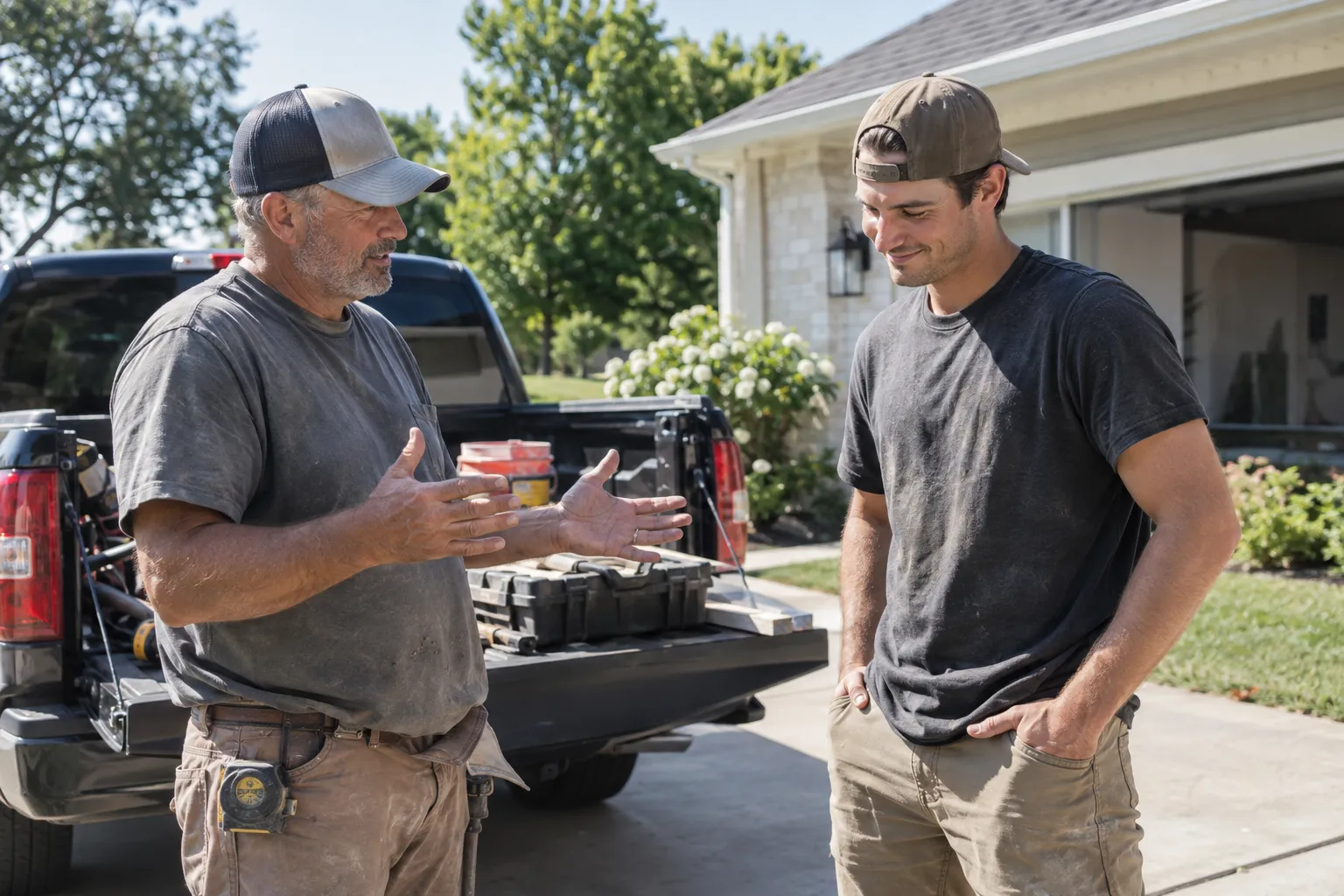
There is a moment I keep coming back to. I was twenty-one, and we had just wrapped a lean-to roof at a farm. Long day. The kind where you are watching the schedule more than the sun, making calls on the fly, trying to keep a crew moving without losing anything in the process. It came together. And at the end of it, my dad pulled me aside and said I had managed the day well.
I could not tell you his exact words now. But I remember exactly how it felt. I walked off that site ready to take on the next one. More than a decade later, that thirty seconds is still shaping how I lead. I think about it when I am deciding whether to say something to one of my guys at the end of a hard push, or whether to just let the day close and move on.
Most of the time, I think we let the day close and move on. Not because we don't care. Because we assume there will be a better moment later, or that the person already knows, or that it would come out awkward. And later never shows up. The thought dies in our heads, and the person we were thinking it about never hears a word.
A Thought That Stays in Your Head Does Nothing for Anyone Else
Scroll through your phone for two minutes and you will find plenty of criticism. Plenty of people pointing out what is wrong, who failed, what fell short. What you will not find much of is genuine encouragement. Not the performative kind, not the emoji-and-exclamation-point kind, but the real thing. Someone who looked at you and said something true and specific and meant it.
Most of us carry kind thoughts about people all day. We notice the guy who showed up early three days running. We see the detail our spouse handled quietly without being asked. We watch a young employee figure something out on his own and think, he is going to be good at this. We think it. We just do not say it.
I am not sure when we decided that keeping a kind thought to ourselves was the safe play. Maybe it feels presumptuous to say it out loud. Maybe we are afraid it will come out wrong. Maybe we genuinely believe the other person already knows. But a thought that stays in your head does exactly nothing for the person you were thinking it about. It helps no one. It builds nothing.
And the gap between what we think it would mean to someone and what it actually means to them is wider than most of us realize. Researchers Erica Boothby and Vanessa Bohns at Cornell found in a 2021 study published in Personality and Social Psychology Bulletin that people consistently underestimate how much their compliments matter to the people who receive them. The givers thought the words would feel small. The receivers felt genuinely moved. That gap is exactly why we hold back. We tell ourselves it probably won't matter that much. We are wrong.
Belief Said Out Loud
A sincere compliment is not really about what someone did. It is belief, said out loud. It tells a person who they are becoming before they can see it themselves. It hands them a picture of themselves they did not know existed.
That is different from flattery. Flattery is general and easy and costs nothing because it means nothing. You know the difference when you hear it. So does the person receiving it. What I am talking about is specific. Earned. The kind of thing you say because you actually saw something.
We had a young man help out at the farm for a while.. Laura worked alongside him most days, and she had a way of making him feel like he mattered. Not flattery. Just steady, honest words from someone who believed in him before he fully believed in himself. Over a few months, you could see it change how he talked, how he carried himself, how he walked into a task. Nothing dramatic happened. Just a person becoming more of who he already was, because someone said it first.
That is what a sincere word does. It is not decoration. It is foundation work. And unlike most foundation work, it does not require any tools, any budget, or any planning. It just requires you to open your mouth and say the thing you were already thinking.
The Invisible Problem
Craig Groeschel has talked about this in his leadership work, the idea that people do not leave jobs or teams primarily because the work is hard. They leave because they feel invisible. Like their effort disappears into the machine without anyone noticing. A word of genuine recognition does not just feel good. It signals to a person that they belong, that their effort is seen, that they matter to what is being built. That is not a small thing. That is the thing somebody builds on.
I have watched this play out on job sites more times than I can count. A guy who has been grinding quietly for weeks, doing good work, not complaining, just showing up. And nobody says a word about it because the work is getting done and there is always something else pressing. Then one day something slips, or he gets an offer somewhere else, and you realize you never once told him you noticed. By then, the moment has passed.
The research on this is consistent. Employee recognition is one of the strongest predictors of engagement and retention, and the absence of it is one of the most common reasons people disengage from their work. We are not talking about formal programs or plaques on the wall. We are talking about a person looking at another person and saying something true. That is it. That is the whole thing.
The People at Home Go the Longest Without Hearing It
Here is something I have had to sit with. The people closest to us often go the longest without a direct word of encouragement. Not because we care about them less. Because we assume they know. Because familiarity makes us lazy in ways we would never be lazy with a customer or a new employee.
I am as guilty of this as anyone. It is easier to say something encouraging to a guy on the crew than to the people at my own dinner table, because with the crew there is a clear moment, a job well done, a day that ended right. At home the work is constant and quieter and harder to name. But that does not mean it goes unseen. It means we have to look harder and say it anyway.
Proverbs 16:24 (NLT) puts it plainly: "Kind words are like honey, sweet to the soul and healthy for the body." There is something almost physical in that image. Words that nourish. Words that do something to a person, not just for them. The people who hear the least of that are often the ones sitting across the table from us every night.

Pick one person tonight. Not a group, not a general statement dropped into the room. One person, and say something specific and true that you have been carrying around in your head. That is the whole assignment.
Say It Before You Get in the Truck
The thing that stops most of us is not unwillingness. It is timing. We will say it later, once we are back in the truck, once the day settles down, once we find the right moment. And the right moment never arrives because we are always moving toward the next thing.
So say it in the moment. While you are still standing there. While it is still true and the person is still in front of you. Thirty seconds is enough. You do not need a speech. You do not need a setup. You just need to say the thing you were thinking.
Specific is better than general. "You handled that well" lands harder than "good job." Name what you actually saw. His patience on a tricky detail. Her consistency on a stretch of hard days. The fact that he asked a good question instead of guessing. The more specific you are, the more the person knows you actually saw them, not just the category of work they were doing.
Oh and one more thing - when someone hands a compliment to you, let it land. Do not shrug it off. Do not deflect it with "oh, it was nothing" or "the whole crew did it." Say thank you and receive it. A compliment is a gift. Shrug it off and you hand it back unopened, and you make it harder for that person to give the next one.
The Brick You Have Not Laid Yet
Every sincere word of encouragement is a brick in someone else's foundation. You do not always get to see where it ends up in the wall. You probably will not remember the exact words you said. Neither will they, most likely. But they will remember how it felt. And that feeling goes to work on a person long after you have both moved on to the next thing.
My dad probably does not remember what he said to me at the end of that day on the farm. I am certain he was not thinking about it as a leadership moment. He just said what he saw. But that thirty seconds has compounded over years in ways neither of us could have predicted when we walked off that job site.
That is what I keep coming back to when I think about this. The cost of saying it is almost nothing. Thirty seconds. A little bit of attention and the willingness to open your mouth. The cost of not saying it is harder to measure, but it is real. Someone goes home without knowing their effort was seen. Someone stays invisible a little longer. Someone carries a question about whether they are becoming who they think they are, and nobody answers it, because the answer was sitting right there in your head and you kept it to yourself.
You have probably got somebody in mind right now. Maybe it is a guy on your crew. Maybe it is your kid. Maybe it is somebody who showed up for you last week and you never said anything about it. That is the one. Say it before the day is over. Add value to every person you meet and project you touch, and sometimes that means the most valuable thing you can offer is just the truth about what you already see in them.
personal-growthroofingcommunitybuildingconstruction